
How Is AI Being Used in Shrimp Farming?
Throughout a shrimp crop, farms generate a constant stream of data. Shrimp are sampled to check growth, water is tested to monitor Vibrio and environmental conditions, while sensors track dissolved oxygen, temperature, pH, salinity, and other changes in the pond.
Having more data certainly gives a farm more visibility, but more data does not automatically lead to better decisions. As stocking density increases and pond conditions change faster, the question is no longer only, “What is the current reading?” It also becomes, “Where is this heading, is something starting to move outside the expected range, and what should the farm do next?”
This is where artificial intelligence, or AI, starts to play a role in shrimp farming.
AI is now being applied in areas such as image-based growth monitoring, feeding, health monitoring, and environmental data analysis. But AI does not replace sensors, automation, or farm experience. In practice, its value comes from helping analyse the data a farm is already collecting and turning that information into something more useful for a specific decision.
In our system, two of the clearest applications today are growth monitoring and Vibrio monitoring. At the same time, the data being collected across the farm is also creating the foundation for a longer-term direction: predictive farm management.
AI Is Not Just Another Name for Automation
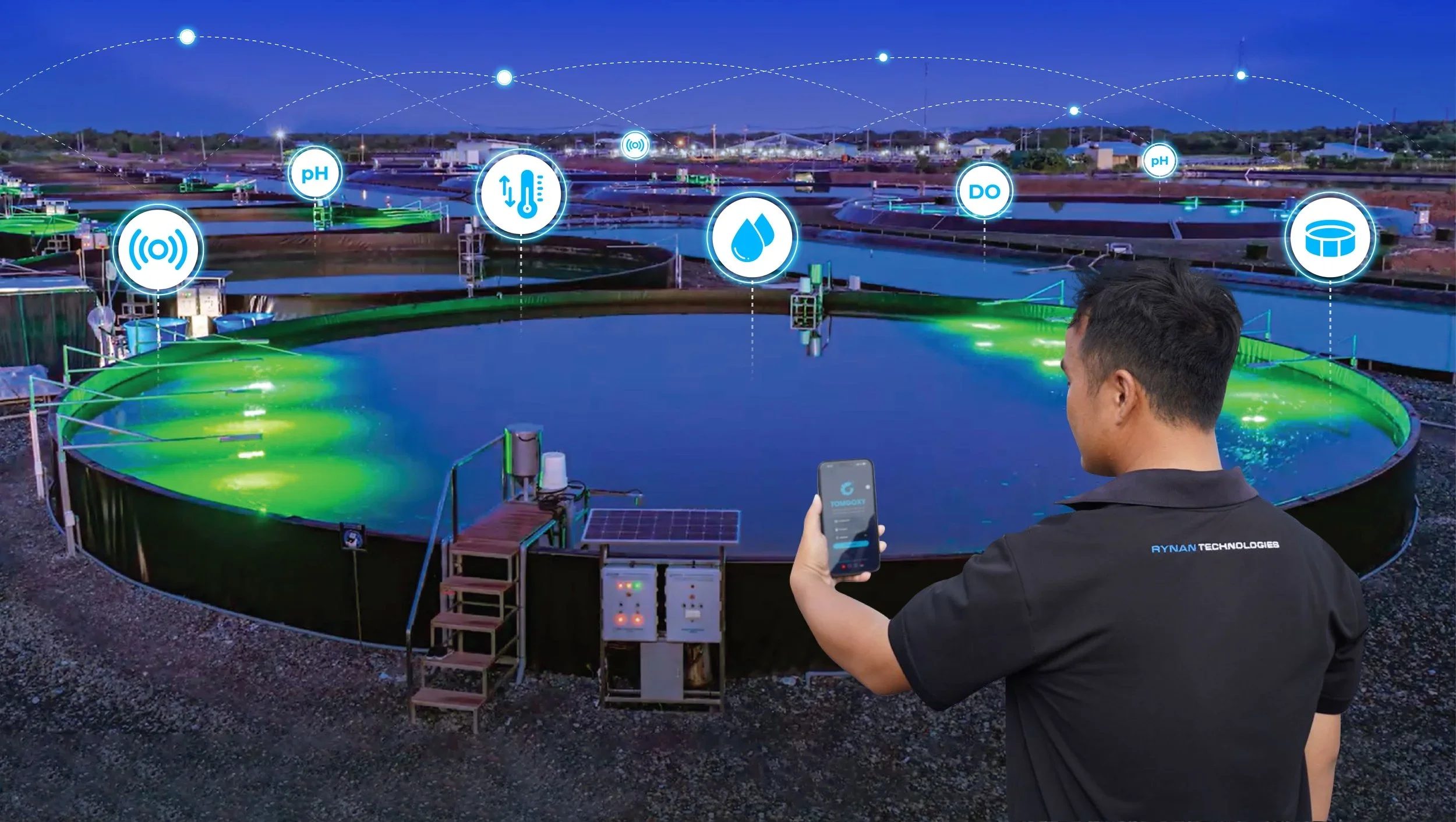
In smart aquaculture, sensors, automation, and AI are often discussed together, which makes them easy to confuse.
A dissolved oxygen sensor tells the farm what the DO level is at that moment. An automated feeder can operate according to a schedule or a predefined rule. AI does something different: it can analyse data to identify patterns, classify images, estimate values, or support prediction.
These layers can work together. Sensors generate data, AI can help analyse it, and automation can then carry out an action based on a rule or an output from the system. But having more sensors and automated devices does not mean everything on the farm is AI.
That distinction matters because, in shrimp farming, the goal is not to add as much technology as possible. Technology only becomes valuable when it helps solve a real operational problem.
Growth Monitoring: From a Single Measurement to a Growth Record
Sampling remains a routine part of shrimp farming. Farm teams collect a group of shrimp, weigh or measure them, and use the result to assess how the crop is progressing.
But each sampling event is still only a snapshot. It tells the farm what a group of shrimp looks like at that point in time, while the bigger operational question is whether growth across the crop is still moving in the right direction.
That is the problem we are trying to address with the RYNAN Vision Bucket.
Around 5–10 shrimp are placed in the bucket and photographed through the TOMGOXY App. The system uses AI-based image analysis to provide information on shrimp size, weight, and certain abnormalities that can be identified from the image.
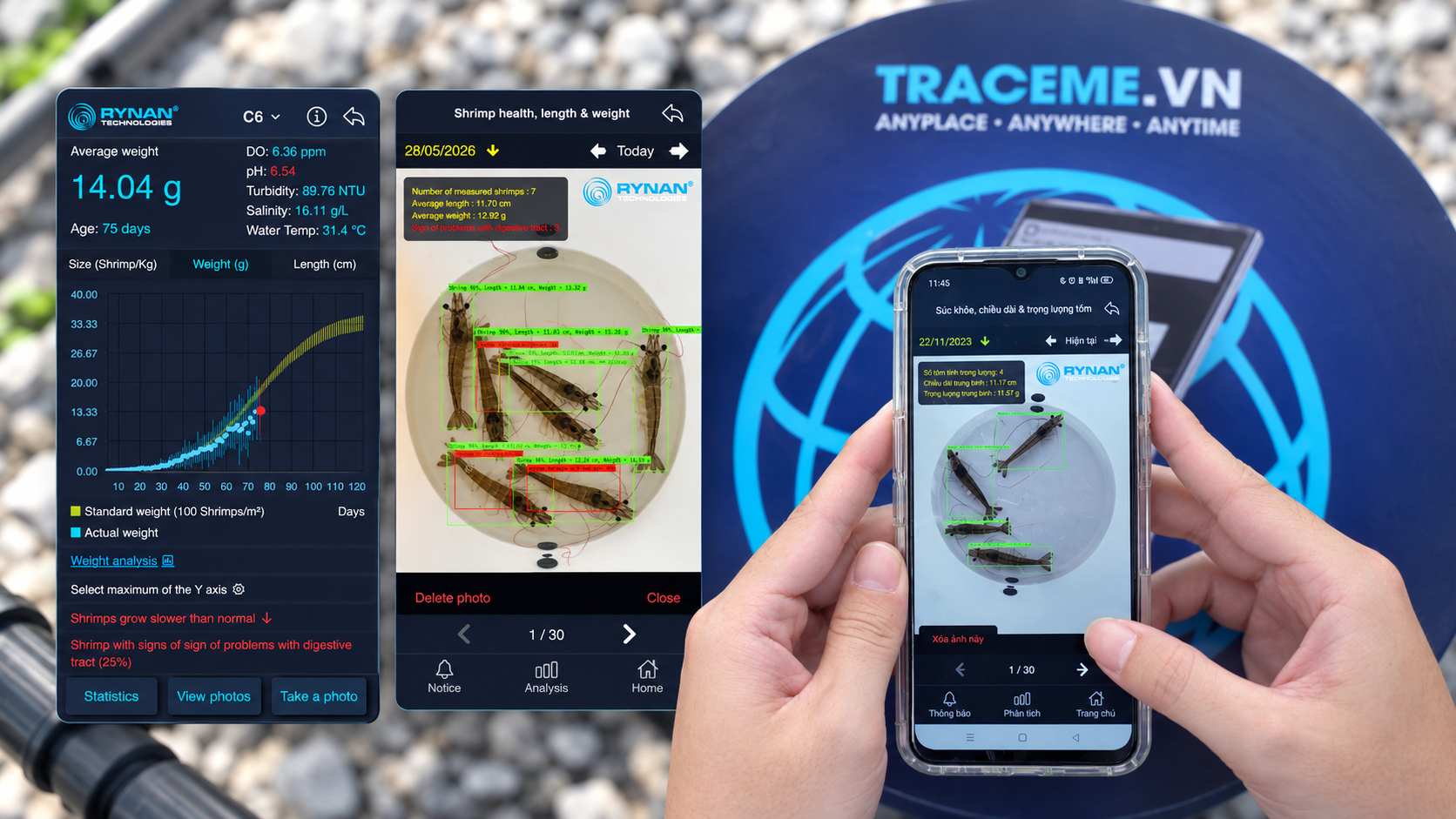
AI-based image analysis measures shrimp size and weight, while repeated scans build a growth record over time.
The more important value comes after that individual measurement. Scan results are stored in the cultivation diary, allowing the farm to review growth history over time and compare it against an expected growth curve.
So AI is not simply replacing a weighing scale with a camera. The aim is to turn repeated sampling into a record that can be followed throughout the crop.
Instead of only asking, “How much do the shrimp weigh today?” the farm can begin to ask, “Is growth still on track, or is it starting to slow down?”
This is also how we presented the application at AquaVision: manual sampling produces one measurement at a time, while each AI Vision image adds another point to the growth history of the pond.
With Vibrio, AI Helps Make Results Easier to Read and Track
Vibrio monitoring presents a different challenge. A farm does not only need to know whether Vibrio is present. It also needs to understand how much is present and how that changes over time.
With the RYNAN AQ-VibrioKit, a sample is cultured on an agar plate. After incubation, the farm captures an image of the colonies and uses the TOMGOXY App to support the classification and counting of different Vibrio groups.
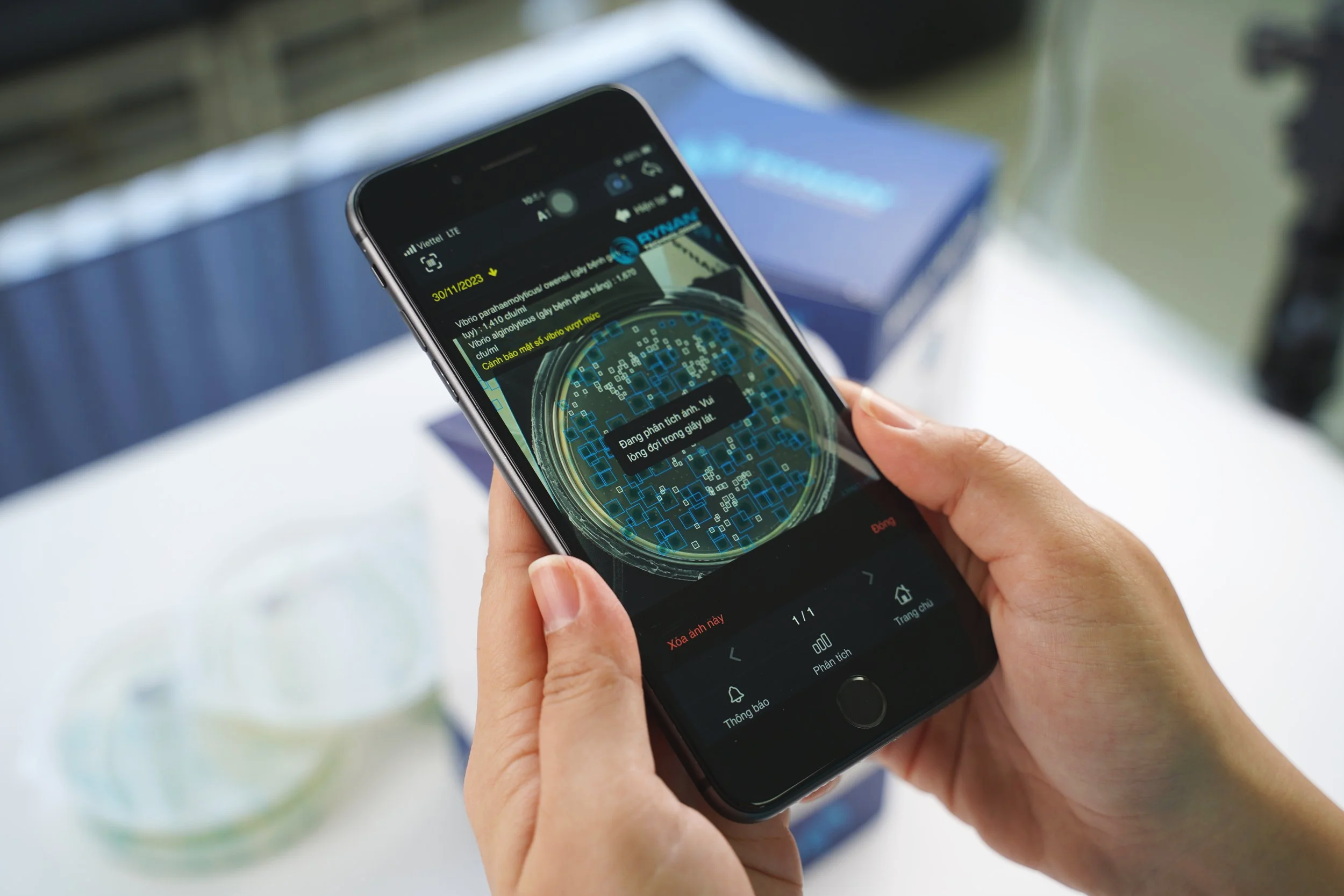
AI-assisted image analysis helps classify and count Vibrio colonies from cultured samples.
In this workflow, AI is not “diagnosing disease.” Its role is to help process the colony image and convert what the farm sees into a more structured quantitative reading.
At AquaVision, we described the workflow simply: colony images are classified, counted, and tracked over time, with visible results available after approximately 24 hours of incubation.
This is useful because a single Vibrio result only describes the condition at one moment. When a farm can track multiple readings over time and view them alongside water quality, growth, or other changes in the pond, the result carries more context for assessing risk and deciding what to do next.
That is ultimately more important to us than simply saying the system “uses AI”: does the information help the farm respond earlier and with more confidence?
From Monitoring What Is Happening to Understanding What May Happen Next
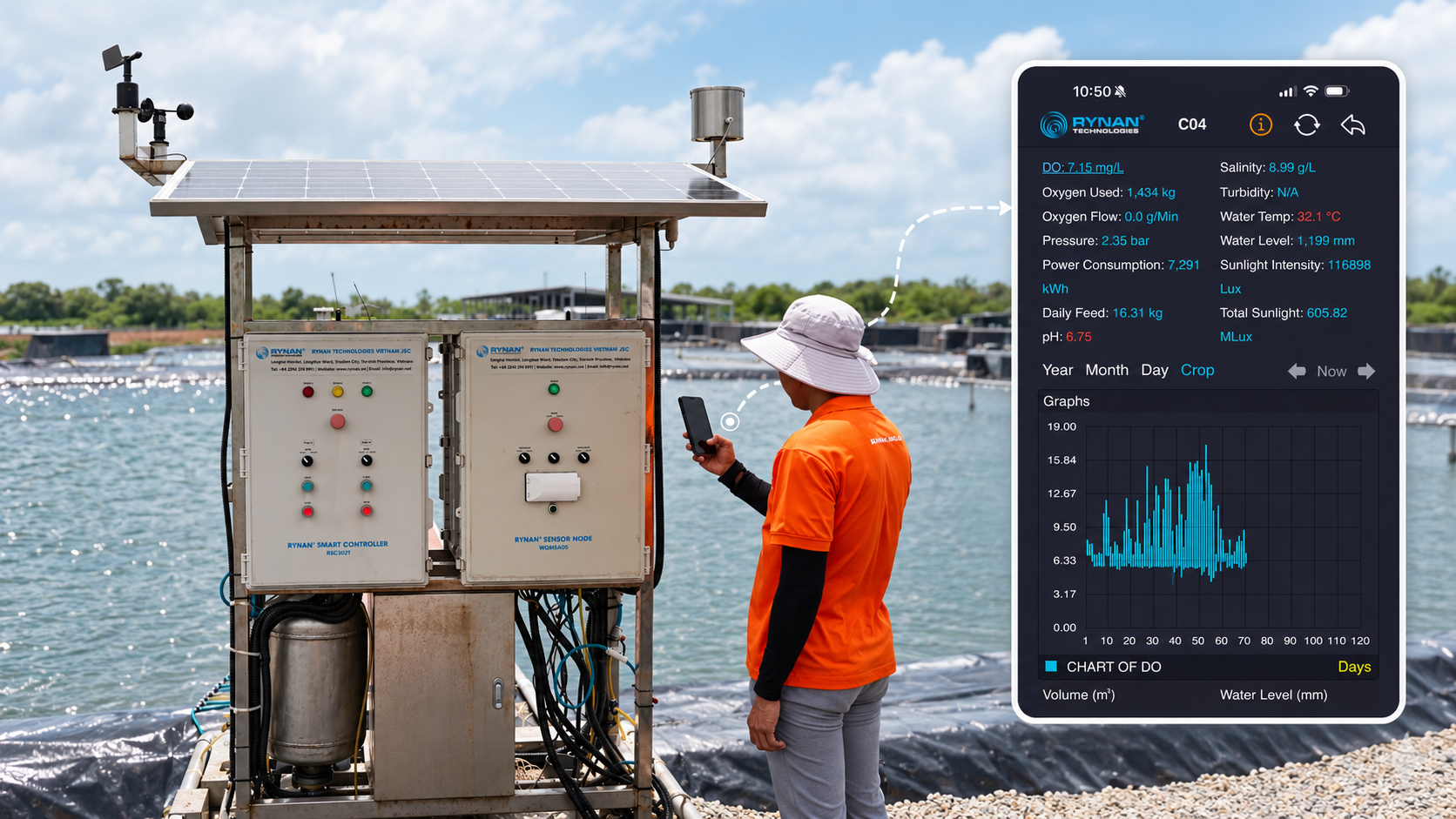
In a connected farm, growth, water quality, oxygen and operational data can be read together rather than as isolated signals.
Water quality and oxygen management are more complex because they do not depend on a single signal.
A DO sensor can tell the farm the current dissolved oxygen level, but oxygen demand in a shrimp pond changes throughout the day. Biomass, feeding, temperature, sunlight, algae activity, and time of day can all influence demand.
That means the same DO reading can carry a different meaning depending on what else is happening in the pond.
When readings are recorded continuously, the farm starts to build a trend rather than simply collecting isolated numbers.
This is the direction we are continuing to develop from our current monitoring system. In AquaVision, we described the logic in three steps: Measure → Build Trends → Forecast Demand.
Sensors collect DO, oxygen flow, temperature, and other signals. TOMGOXY organises those readings over time. The next step is to use predictive AI to analyse those trends and support the estimation of oxygen demand before DO approaches a critical level.
This should be distinguished from Vision Bucket or AQ-VibrioKit, which already have specific workflows in use today. Predictive oxygen and water-quality management is still a direction we are building on top of the data already being collected across the farm.
The objective is straightforward: instead of only seeing a problem after a threshold has already been crossed, the farm may have more time to recognise the direction of change and respond earlier.
Why We Do Not Look at AI as a Standalone Device
When we first started developing technology for shrimp farming, one of our early directions was a smart feeder. Feed is one of the major operational costs on a shrimp farm, so improving feeding accuracy was an obvious place to start.
But working at the farm showed us a clear limitation. A feeder can distribute feed very precisely, but if dissolved oxygen cannot keep up with biomass, waste is accumulating, or water quality is becoming unstable, optimising feeding alone does not solve the problem in the pond.
That was one of the reasons we moved from focusing on a single smart device toward a broader approach: designing the farm as a connected system where pond design, oxygen, water movement, feeding, monitoring, and data support one another.
AI needs to be viewed in the same context.
It cannot make a poorly calibrated sensor accurate. It cannot compensate for inconsistent sampling, or correct a pond with underlying oxygen or waste-management problems. A prediction is also of limited value if the farm has no way to act on it.
That is why one principle we emphasised at AquaVision was: AI needs connected farm data, not isolated readings.
Sensors generate signals. Farm records add context. AI becomes more useful when those data points can be read together over time.
So What Value Does AI Actually Bring to a Shrimp Farm?
The most important question is not whether a technology carries an “AI” label. but it is what the technology helps the farm do better.
For growth monitoring, AI vision can help turn repeated sampling into a growth history that is easier to follow. For Vibrio monitoring, image analysis can help convert colony images into quantitative readings that can be stored and compared over time. For water quality and oxygen management, connected sensor data is creating the foundation for us to move from real-time monitoring toward earlier trend recognition and predictive support.
But AI is not the starting point. The starting point is still a clear operational problem, reliable enough data, and a farm system capable of acting on the information it receives.
That is also how we are developing TOMGOXY: not by treating AI as a standalone feature, but as part of a broader process that connects monitoring, farm data, and operations so that decisions can become earlier, more consistent, and better informed.