
Reducing Shrimp Feed Costs: Why a Smart Feeder Alone Is Not Enough
In intensive and super-intensive shrimp farming, feed is often one of the largest operating costs on the farm. So when farmers look for ways to improve profitability, one practical question usually comes first: how can we reduce feed cost without affecting shrimp growth?
One common answer is to use an automatic feeder or smart feeder. These tools can help distribute feed more accurately, reduce manual guesswork, and support better feeding consistency.
But in real farm operation, feed optimization is not only about the feeding device.
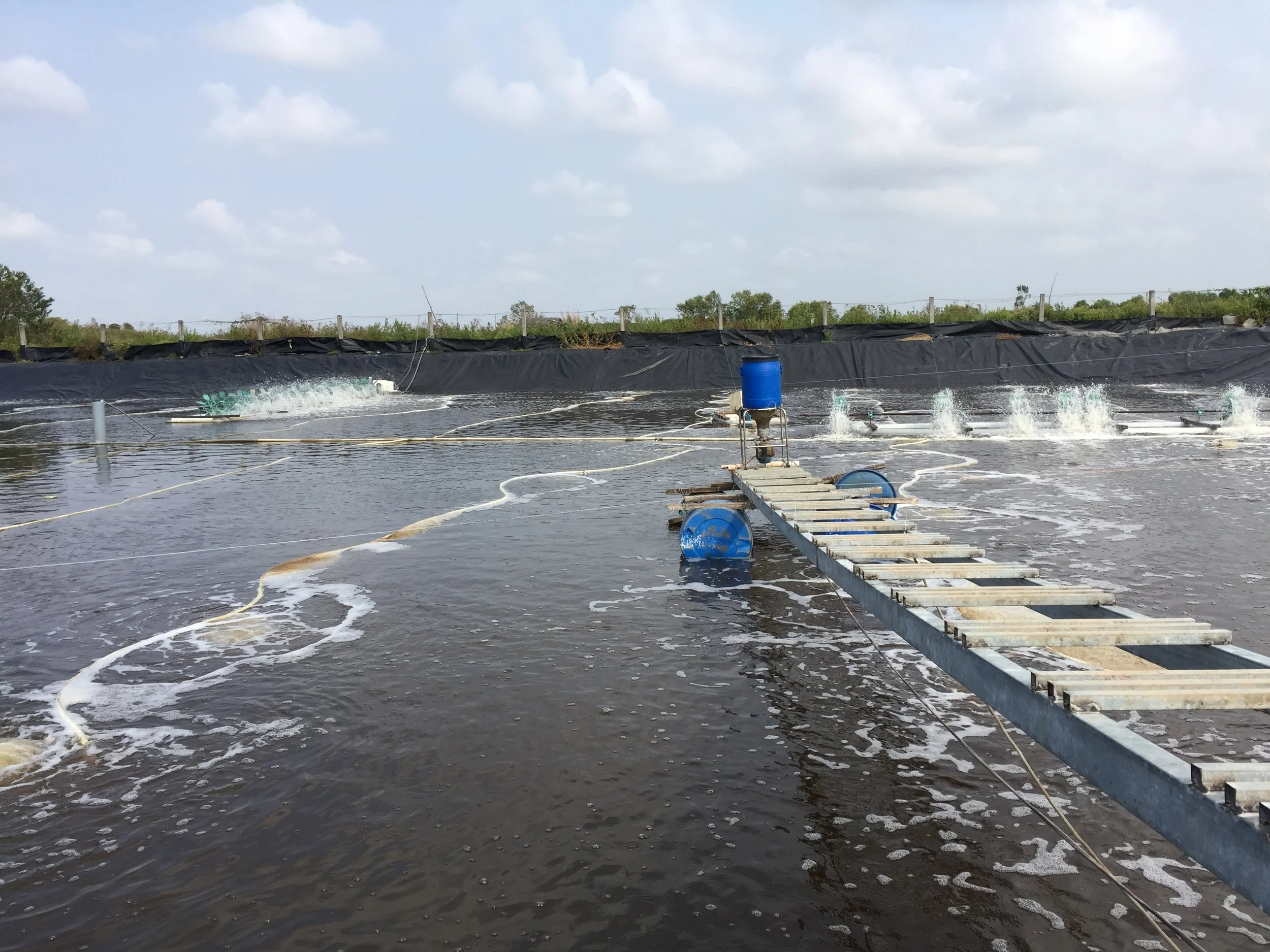
A smart feeder can help deliver feed at the right time and in the right amount. But if shrimp are living in unstable dissolved oxygen conditions, if organic waste is accumulating at the pond bottom, or if water quality is changing rapidly, precise feeding alone may not be enough to improve FCR.
In other words, reducing feed cost sustainably requires a wider view. Farms need to control not only how much feed enters the pond, but also the pond conditions that allow shrimp to eat well, digest well, and convert feed into body weight.
Why feed cost is a major pressure in shrimp farming?
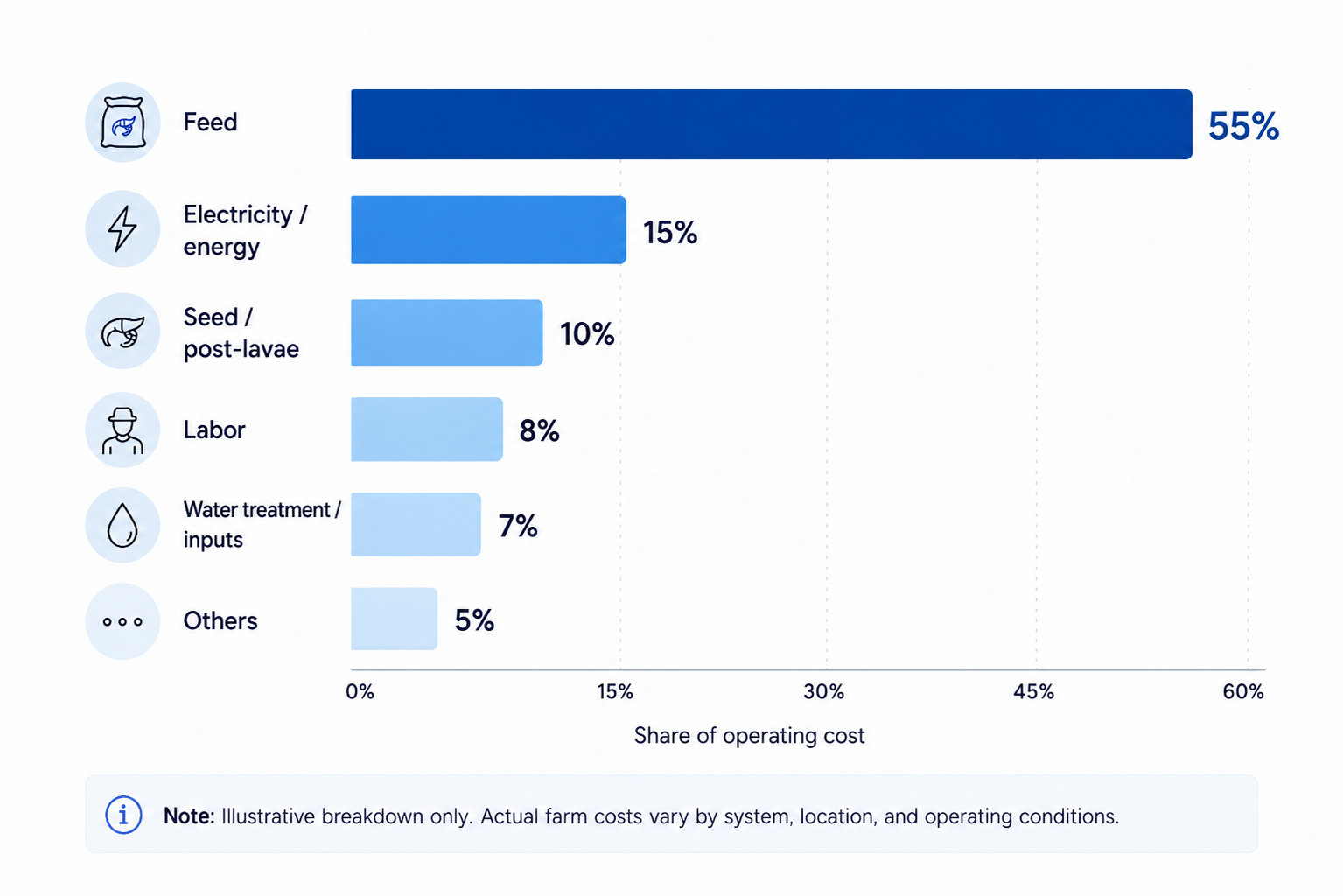
Feed is commonly reported as the largest production cost in shrimp farming, making feed efficiency a key factor in farm profitability. Actual farm costs may vary by system, location, and operating conditions.
Feed is one of the biggest operating costs in shrimp farming. When feed prices rise, shrimp prices fluctuate, and margins become tighter, even a small increase in FCR can have a major impact on farm profitability.
For example, if two farms harvest the same biomass but one farm uses more feed to reach that output, its production cost per kilogram of shrimp will be higher. On the other hand, if a farm can control feed use more effectively and help shrimp convert feed more efficiently, profitability can improve without necessarily increasing stocking density or expanding farm area.
This is why FCR is not only a technical indicator. It is also an operational and financial indicator.
However, FCR is not determined by feed formula or feeding equipment alone. It is also affected by dissolved oxygen, temperature, pH, pond bottom condition, shrimp health, stocking density, water movement, and daily farm management decisions.
What a smart feeder can help with
Automatic feeders and smart feeders play an important role in improving feed management.
Instead of relying fully on manual feeding, fixed schedules, or personal experience, automatic feeding systems help farms control feeding frequency, feed volume, and feeding timing more consistently. This is especially useful in high-density farming, where manual feeding can become difficult to manage accurately.
A smart feeder can help farms:
Distribute feed more evenly throughout the day
Reduce variation caused by manual operation
Avoid overfeeding in a single feeding session
Adjust feed volume according to shrimp growth stage
Provide better data for farm decision-making
But a smart feeder is only one part of the farm operating system. If it works alone, without being connected to pond data and real farm conditions, its impact will be limited.
The limitation of smart feeders in unstable pond conditions
A feeding machine can calculate feed volume based on shrimp size and culture days. But shrimp do not eat according to a fixed formula.
Their feeding behavior changes with the environment.
When dissolved oxygen drops, shrimp often become less active and reduce feeding. When organic waste builds up at the pond bottom, toxic compounds and microbial pressure can increase, causing shrimp stress. When temperature, pH, or alkalinity changes too quickly, feeding response and digestion may also be affected.
Under these conditions, if the feeder continues to operate based on a fixed schedule, uneaten feed will sink to the pond bottom. This does not only increase direct feed waste. It also decomposes, worsens water quality, and adds more pressure to the pond environment.
This is a common cycle in shrimp farming:
The hidden cost is not only feed, it is the cycle created by feed waste
So the issue is not whether a smart feeder is useful. The real question is whether the feeder is operating inside a pond system that is stable enough for shrimp to eat and convert feed efficiently.
To reduce FCR, farms need to control three fundamentals
To optimize feed cost in shrimp farming, farms need to focus on three fundamentals before looking only at the feeding device.
1. Stable dissolved oxygen
Dissolved oxygen is one of the most important factors affecting shrimp feeding response and feed conversion.
When DO is stable, shrimp have better conditions to stay active, feed properly, and digest efficiently. When DO drops, especially at night or after sudden weather changes, shrimp may reduce feeding or stop feeding. If the farm continues feeding based on a fixed schedule, feed waste will increase.
This is why feed management cannot be separated from oxygen management.
2. A cleaner pond bottom with better waste removal
In high-density shrimp farming, feces, uneaten feed, and organic matter accumulate quickly. If the pond bottom is not designed to collect and remove waste effectively, these materials can spread across the pond bottom and decompose inside the culture environment.
This increases the risk of toxic compounds, bacterial pressure, and shrimp stress.
A dirty pond bottom directly affects shrimp health and feeding behavior. When shrimp are under stress, simply increasing or reducing feed volume through a feeder does not solve the root problem.
3. Real-time pond and growth data
To feed accurately, farms need to understand shrimp growth, feeding response, and whether the pond condition is suitable for continued feeding.
If feeding decisions depend only on fixed schedules or manual estimation, it is easy to overfeed or underfeed. But when farms have data on DO, pH, temperature, growth, and shrimp condition, feeding decisions become more grounded.
This is the difference between “automatic feeding” and “data-driven feed management.”
A system approach: not just smart feeding, but smarter pond operation
To reduce feed cost in a practical way, farms need to move from “buying one device to solve one problem” to “building a system that helps the pond operate more consistently.”
In the TOMGOXY® system, feed optimization is not treated as a separate function. It is connected with pond design, water movement, oxygen delivery, waste removal, sensor data, shrimp growth monitoring, and daily farm decision-making.
The goal is not only to deliver feed more accurately. The goal is to create the right conditions for shrimp to eat better, digest better, and convert feed into biomass more efficiently.
How TOMGOXY® supports feed optimization
Pond design that supports better bottom control
TOMGOXY® uses a 10° sloped pond bottom designed toward the center, combined with a siphon system to support the collection and removal of organic waste.
This design helps reduce waste accumulation across the pond bottom and supports a more stable pond environment. When the pond bottom is better controlled, farms have a stronger foundation for maintaining feeding response and reducing the risk of uneaten feed becoming a secondary source of pollution.
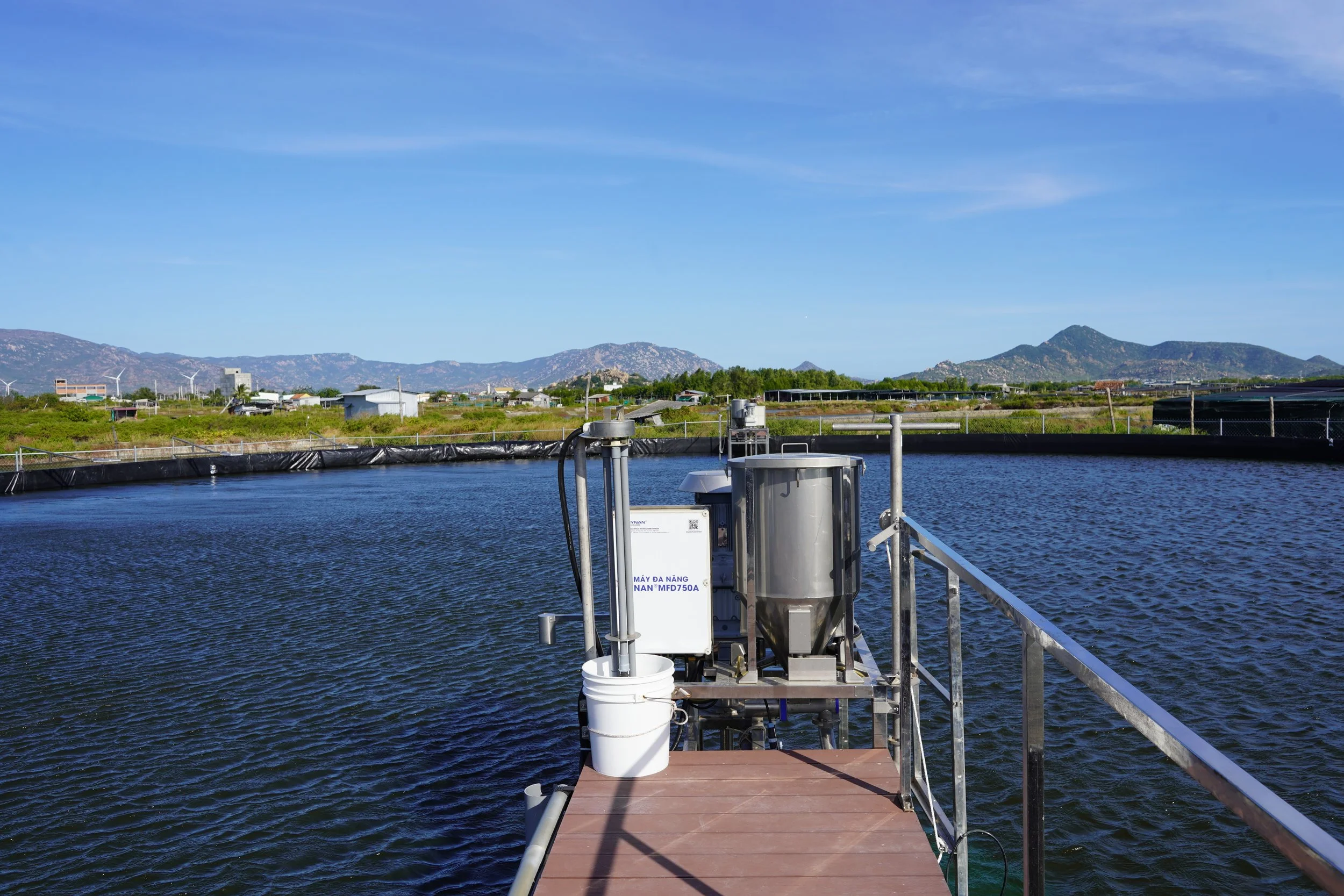
The Multifunctional Device supports controlled water movement and oxygen distribution inside the TOMGOXY® pond system.
Multifunctional Device supports water movement and oxygen distribution
The Multifunctional Device (MFD) in the TOMGOXY® system is designed to support water circulation, oxygen distribution, and feeding strategy inside the pond.
Instead of only creating strong surface movement, the MFD supports more controlled water movement within the pond. When combined with stable dissolved oxygen, the system helps create better conditions for shrimp to feed and convert feed.
This does not mean that a device alone will automatically reduce FCR. Results still depend on farm operation, stocking density, seed quality, water quality, and daily management discipline. But when oxygen, water movement, and pond bottom design are planned together, feeding decisions have a stronger operating foundation.
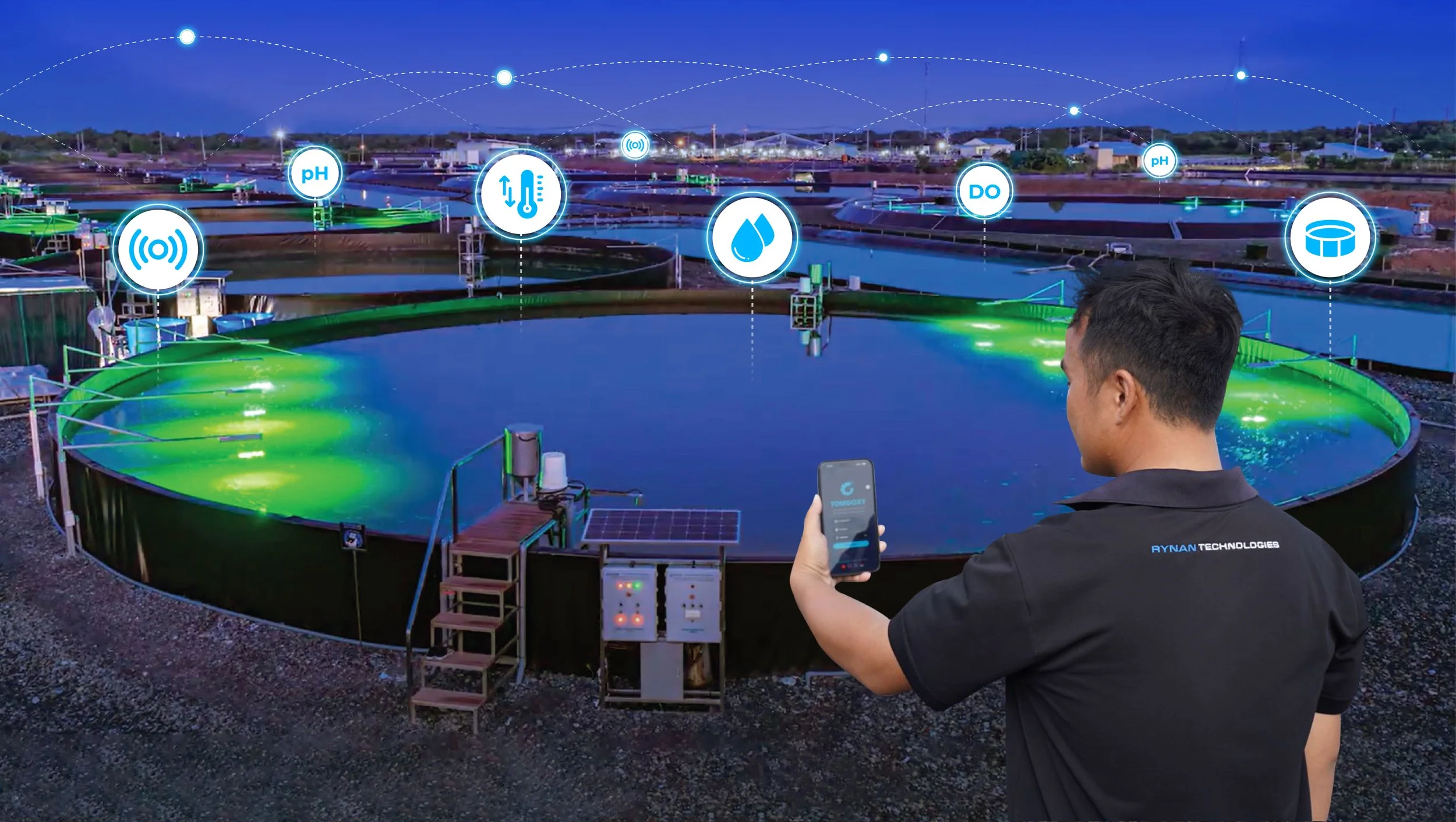
Connected sensor data helps adjust feeding decisions based on real pond conditions, not fixed schedules alone.
Sensor data helps adjust feeding based on pond conditions
In a data-driven operating model, feeding decisions should not rely only on fixed feeding times.
Parameters such as DO, pH, temperature, and environmental changes help operators understand whether the pond is in a suitable condition for continued feeding. When the data shows that pond conditions are not favorable, the farm can adjust feed volume, reduce a feeding session, or pause feeding to limit waste.
This is more practical than allowing the feeder to operate independently.
A smart feeder is still important. But it needs to sit within a system that can respond to pond conditions.
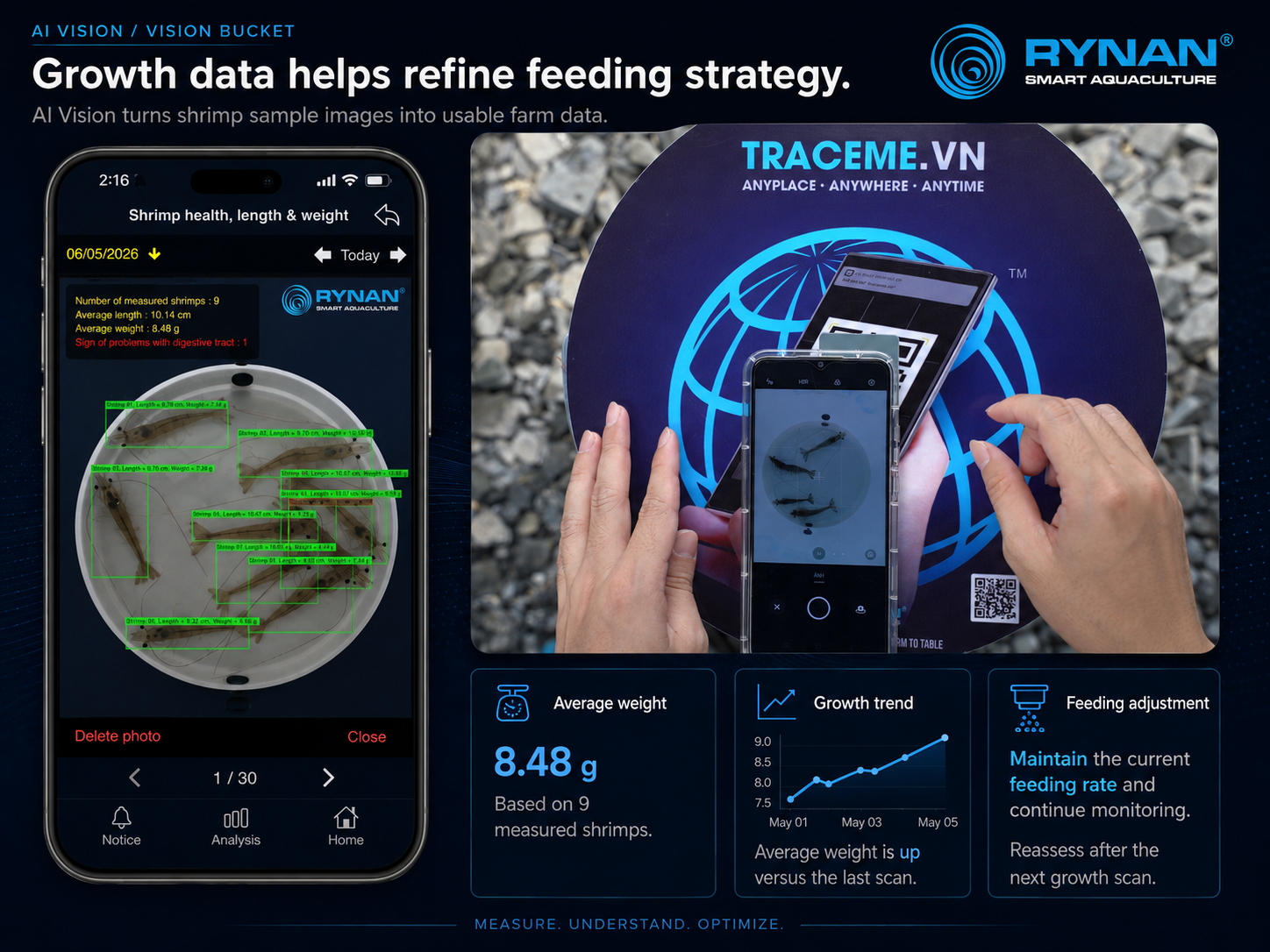
RYNAN Vision Bucket supports shrimp size and growth monitoring through AI-powered sample image analysis.
AI Vision supports shrimp growth monitoring
Another important part of feed management is growth monitoring. If a farm does not have a clear view of average shrimp weight, growth rate, and sample condition, feed adjustment can easily become delayed or inaccurate.
With AI Vision technology such as RYNAN Vision Bucket, operators can digitize the process of measuring shrimp size and average weight from sample images. This data helps farms track growth over time and compare actual growth with the current feeding strategy.
When growth data is combined with pond environmental data, farms gain a more complete view: whether shrimp are eating well, whether they are converting feed efficiently, and whether the feeding strategy needs to be adjusted.
Reducing feed cost starts with reducing feed waste
In shrimp farming, reducing feed cost does not simply mean feeding less. If feed is reduced at the wrong time, shrimp growth can slow down, the crop cycle may become longer, and other costs may increase.
A more practical approach is to reduce wasted feed.
Feed waste happens when feed enters the pond but shrimp do not eat it, do not digest it well, or do not convert it efficiently into body weight. That is why controlling feed cost requires improving the entire environment around shrimp feeding behavior.
This includes:
Maintaining stable dissolved oxygen
Controlling pond bottom waste and organic matter
Monitoring environmental changes in real time
Adjusting feeding according to pond conditions
Tracking shrimp growth with data
Connecting feeding equipment with the overall farm operating logic
When these factors are better controlled, farms can improve FCR and reduce feed cost pressure more sustainably.
A smart feeder is useful, but it should not work alone
A smart feeder can be an important part of a feed optimization strategy. But if a farm only invests in feeding equipment without addressing the pond’s fundamental operating conditions, its impact will be limited.
A pond with unstable oxygen, accumulated waste, fluctuating water quality, and disconnected data will make it difficult for any smart device to deliver its full value.
On the other hand, when a smart feeder is connected to a well-designed pond system with oxygen control, water movement, waste removal, and growth monitoring, feed management becomes more accurate and more practical.
Better feed conversion starts with better farm operation
Reducing feed cost in shrimp farming does not start with simply feeding less. It starts with understanding when shrimp are able to feed well, when feeding should be adjusted, and which pond conditions are affecting feed conversion.
A smart feeder is a useful tool. But to improve FCR and reduce feed waste, farms need more than an automatic feeding device.
They need an integrated operating system where pond design, oxygen, water movement, water quality, sensor data, and shrimp growth monitoring all support one shared goal: helping every kilogram of feed convert more efficiently into harvestable shrimp biomass.
This is how TOMGOXY® approaches feed cost optimization — not by focusing only on feeding sessions, but by managing the full set of pond conditions that help shrimp feed better and farms operate more consistently.