
Shrimp Farming at 200–400 Shrimp/m²: Why High-Density Farming Requires a Fully Integrated System
Traditional shrimp farming is facing increasing pressure from limited land availability, declining water quality, and more unpredictable climate conditions. In this context, increasing production by simply expanding farm area is no longer an easy option in many regions.
As a result, the shrimp farming industry is gradually shifting toward models that can produce more on the same land area, but with a higher level of operational control. This is why super intensive shrimp farming design is not only about stocking density. It is about how oxygen, water movement, waste, data, and farm decisions are controlled as one integrated system.
At stocking densities of 200 shrimp/m² or higher, farmers can no longer rely only on experience, paddlewheels, and water exchange in the same way as traditional farming models. The higher the density, the faster oxygen demand, waste load, bottom pressure, and water-quality risks increase. Without an integrated engineering design, increasing density can make operational risk rise faster than production output.
This is the design foundation behind the TOMGOXY® farm model by RYNAN Aquaculture: a super intensive shrimp farming model built as an integrated operating system, connecting pond structure, oxygen supply, water movement, waste collection, data monitoring, and operational decision-making within the same logic.
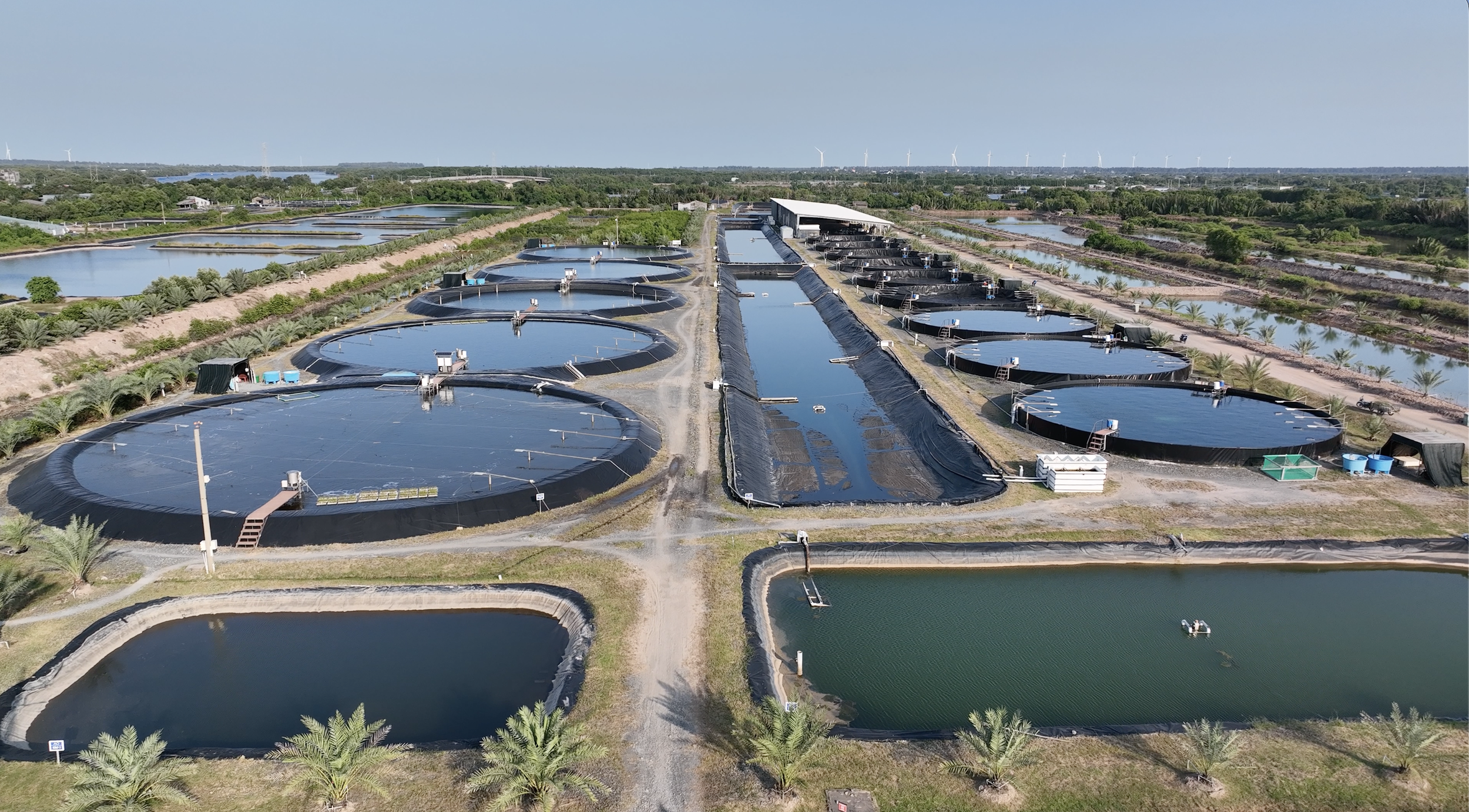
Aerial view of TOMGOXY farm layout designed for controlled high-density shrimp farming
Why high-density shrimp farming often fails
In shrimp farming, increasing density is not simply a matter of stocking more postlarvae into the same pond area. As stocking density increases, the entire pond system is placed under greater pressure.
Oxygen demand increases with biomass. Feed input increases. Shrimp feces, uneaten feed, and molted shells accumulate faster. The pond bottom becomes more vulnerable to organic overload. Water quality becomes more unstable, especially at night and during the later stages of the crop when shrimp biomass rises quickly.
If the pond is not designed to control these factors, farms often face familiar problems: unstable dissolved oxygen, waste dispersed across the pond bottom, inconsistent feeding response, higher FCR, increased risk of Vibrio and toxic gases, and difficulty standardizing operations across multiple ponds.
Therefore, the core question in super intensive shrimp farming is not simply “how can we farm at higher density?”
The more important question is:
How can the pond system continue to control oxygen, water movement, waste, and operational decisions as biomass increases?
From traditional ponds to a controlled operating system
In many intensive shrimp farms, operational decisions still depend heavily on the experience of farm managers. Water checks, aeration adjustments, feeding, water exchange, and siphoning are often carried out based on fixed schedules or in response to problems after they have already appeared.
This approach may work at lower densities. But when vannamei stocking density per square meter increases to 200–400 shrimp/m², the margin for error becomes much smaller.
A drop in dissolved oxygen at night, a waste accumulation zone at the pond bottom, or a period of reduced feeding response can directly affect growth, FCR, and survival rate if not detected early.
TOMGOXY approaches this challenge from a system-design perspective. Instead of adding separate devices into an existing pond setup, the model is designed around five key operational layers:
Pond structure
Water movement and waste collection
Stable oxygen supply
Pond data monitoring
Operational decision support
When these five layers work together, the farm can manage high-density conditions with greater control instead of only reacting when problems occur.
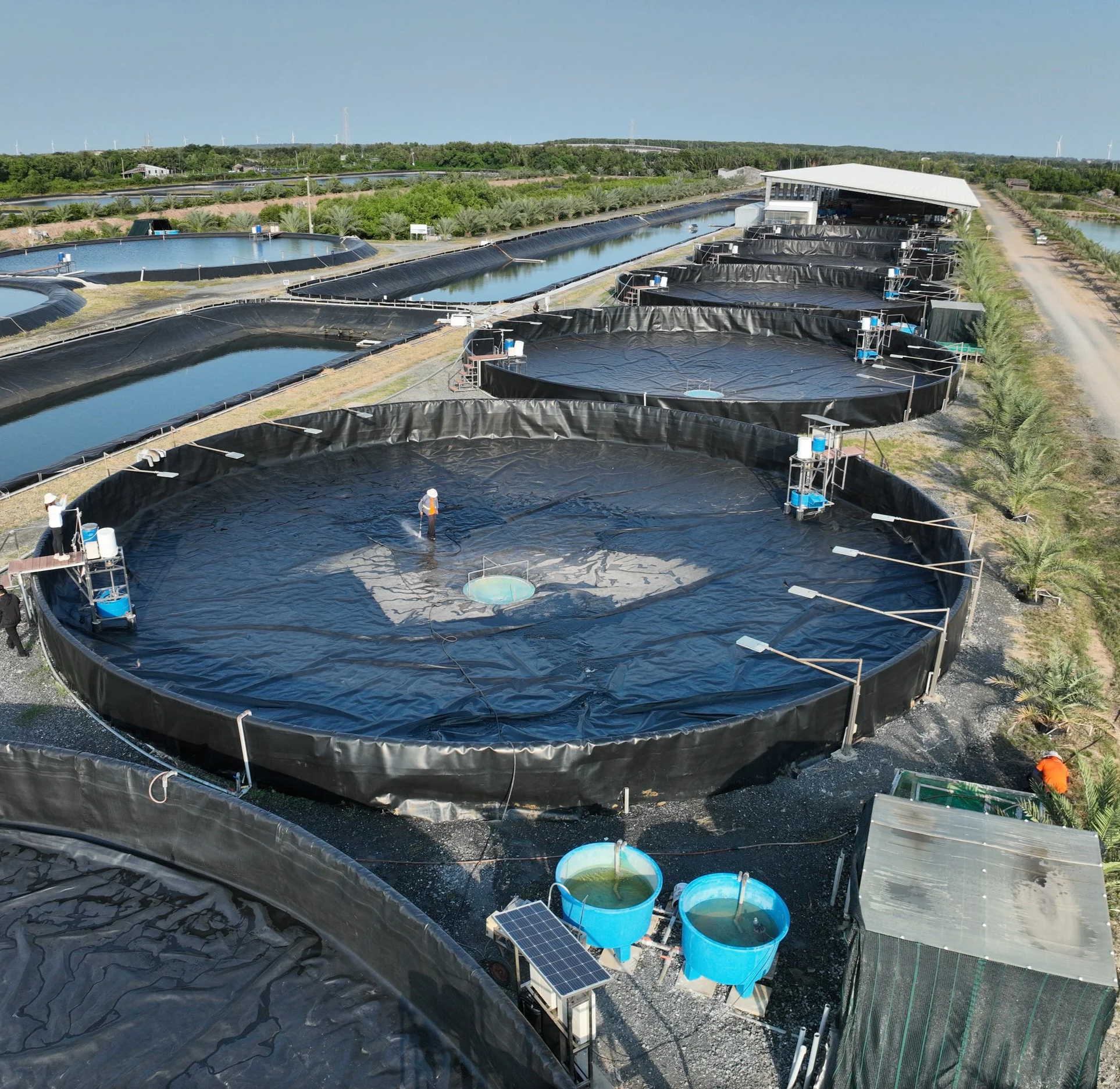
In high-density farming, pond structure is not just infrastructure. It determines how water movement, waste collection, and oxygen distribution can be controlled throughout the crop.
1. Pond structure: the foundation of high-density farming
A super intensive shrimp farm cannot simply start with a traditional earthen pond and add more equipment. The pond structure itself must be designed from the beginning to support bottom control, water movement, and waste collection.
In the TOMGOXY model, grow-out ponds are designed with a 10° sloped bottom toward the center. This structure helps solid waste, shrimp feces, uneaten feed, and molted shells move toward the collection point instead of spreading across the entire pond bottom.
The key difference is that the pond is not treated as a static body of water. It is treated as a production environment where water movement must be directed and controlled. When flow is properly managed, waste can be concentrated more effectively toward the siphon point, reducing bottom pressure and supporting a more stable environment for shrimp.
This is one of the reasons why physical pond design plays such an important role in super intensive shrimp farming design. If the pond bottom, water flow, and waste collection points are not designed correctly, higher stocking density can quickly create operational bottlenecks.
2. Water movement and waste collection: controlling what is often overlooked
In high-density shrimp farming, waste is not only a pond hygiene issue. It is one of the key factors that determines bottom condition, water quality, and feeding efficiency.
When waste accumulates or spreads across the pond bottom, organic decomposition can increase pressure on the water environment. This affects dissolved oxygen, raises the risk of toxic gases, and creates more favorable conditions for microbial problems to develop.
TOMGOXY uses the RYNAN Multifunctional Device (MFD) to support controlled water movement in the pond. The goal is not to create strong water movement randomly, but to create a controlled circulation pattern that helps move waste toward the center collection area for siphoning.
When waste is collected and removed more consistently, the farm can reduce organic pressure in the pond. This becomes especially important when biomass increases during the middle and later stages of the crop.
In other words, in a super intensive farming model, waste management is not a secondary step after feeding. It is a core part of the operating design.
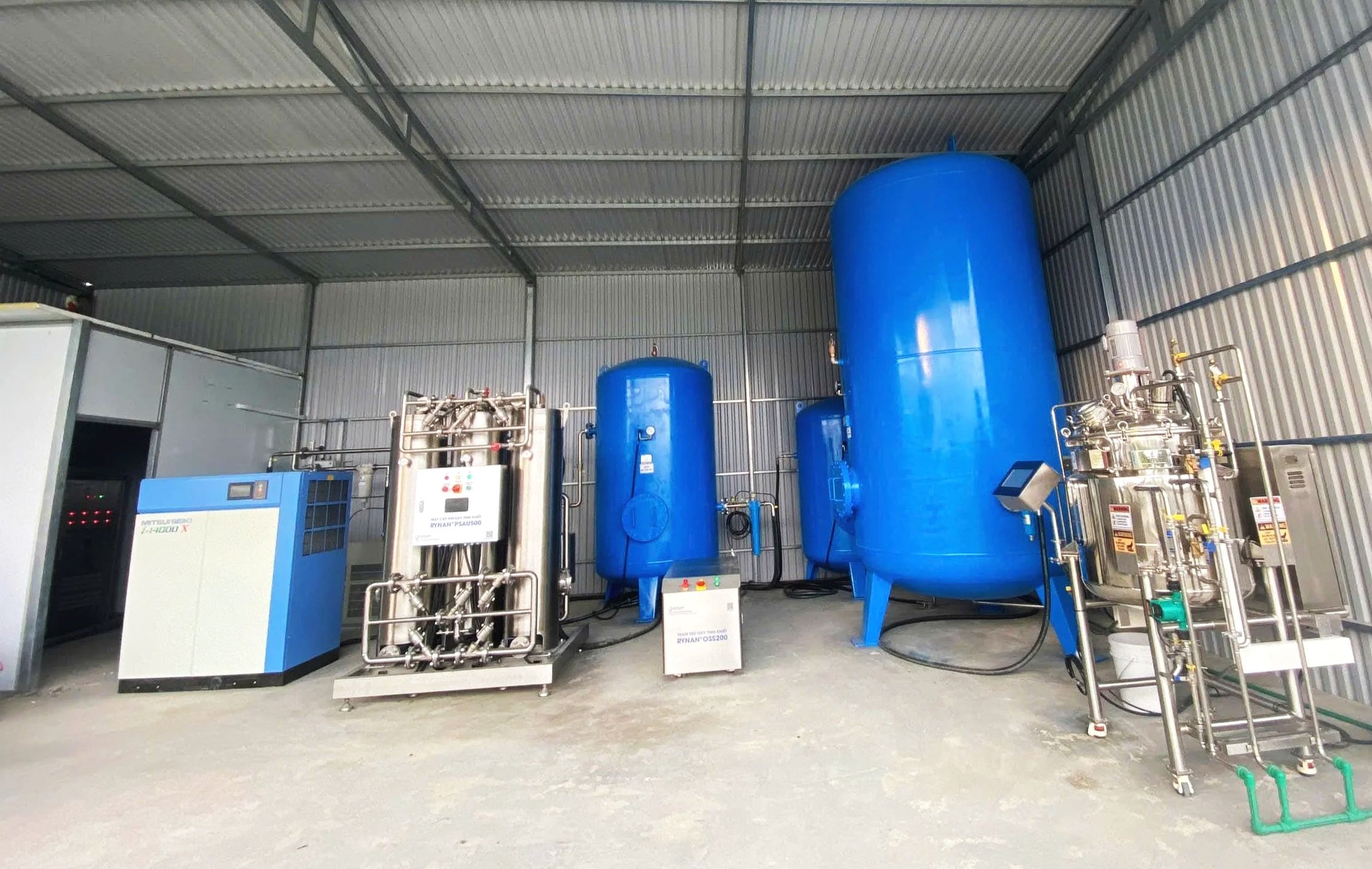
High-density biomass requires a more stable oxygen strategy. The oxygen system supports dissolved oxygen control beyond surface water movement alone.
3. Stable oxygen supply: a critical condition as biomass increases
Dissolved oxygen is one of the biggest limiting factors in high-density shrimp farming. As shrimp grow, the oxygen demand of the entire pond rises quickly. At the same time, organic load also increases, meaning the system requires more oxygen to maintain a stable environment.
In many traditional ponds, oxygen is supplied mainly through paddlewheels. This method can support oxygen diffusion and surface water movement, but it often reaches its limits when density and biomass increase, especially near the pond bottom and at night.
TOMGOXY uses the RYNAN Oxygen Generator to produce high-purity oxygen, combined with an oxygen distribution system in the pond. This approach helps farms maintain more stable oxygen conditions under high-density farming, while reducing dependence on continuous paddlewheel operation in the traditional way.
With the right design, the TOMGOXY oxygen system can help significantly reduce electricity consumption compared with models that rely heavily on paddlewheels, with energy savings of up to 70% depending on farm configuration and operating conditions.
The key point is not simply having “more oxygen.” It is supplying oxygen in a way that matches the biological demand of the pond. In high-density farming, stable oxygen helps shrimp maintain better feeding activity, reduce stress, and support feed conversion efficiency.
4. Pond data: from measurement to operational decisions
One of the biggest limitations in many farms is that data is measured but not translated into timely action. Farmers may measure dissolved oxygen, pH, temperature, or salinity, but if the data is recorded in isolation, decision-making still depends largely on intuition.
In TOMGOXY, pond data is treated as an important operating layer. Devices such as RYNAN AQ-Multisense support the monitoring of environmental parameters such as dissolved oxygen, pH, temperature, and salinity. These data points are recorded and synchronized so operators can track changes in pond conditions over time.
The value is not only in a single reading at a single moment. The real value lies in the trend.
For example, if DO begins to drop faster at night, if pH fluctuates more sharply during the day, or if shrimp show a weaker feeding response, operators need to detect these signals early so they can adjust oxygen, feeding, siphoning, or conduct further water-quality checks.
This is the foundation of precision aquaculture: data does not replace the farm manager, but it helps them make faster, more consistent, and more evidence-based decisions.
5. Managing growth, biomass, and harvest timing
In high-density farming, the question is not only whether shrimp are growing. The more important question is whether the pond still has enough carrying capacity to continue farming efficiently.
As biomass increases, oxygen demand, feed input, waste load, and environmental pressure all increase. If the farm continues to hold high biomass while the pond is approaching its operational limit, shrimp growth may slow down, FCR may increase, and environmental risk may become higher.
TOMGOXY supports operators in monitoring growth and biomass through tools such as RYNAN AQ-Vision. Camera technology and image analysis make it possible to record shrimp size more frequently, reducing dependence on manual sampling.
When growth data, feeding response, water quality, and pond conditions are reviewed together, the farm has a stronger basis for deciding whether to continue growing, adjust feed, reduce pond load, or conduct partial harvesting.
In some cases, partial harvesting can help reduce biomass pressure, improve pond conditions, and create more space for the remaining shrimp to continue growing. This should not be a fixed schedule-based decision. It should be based on the actual pond condition and the production objective of each crop.
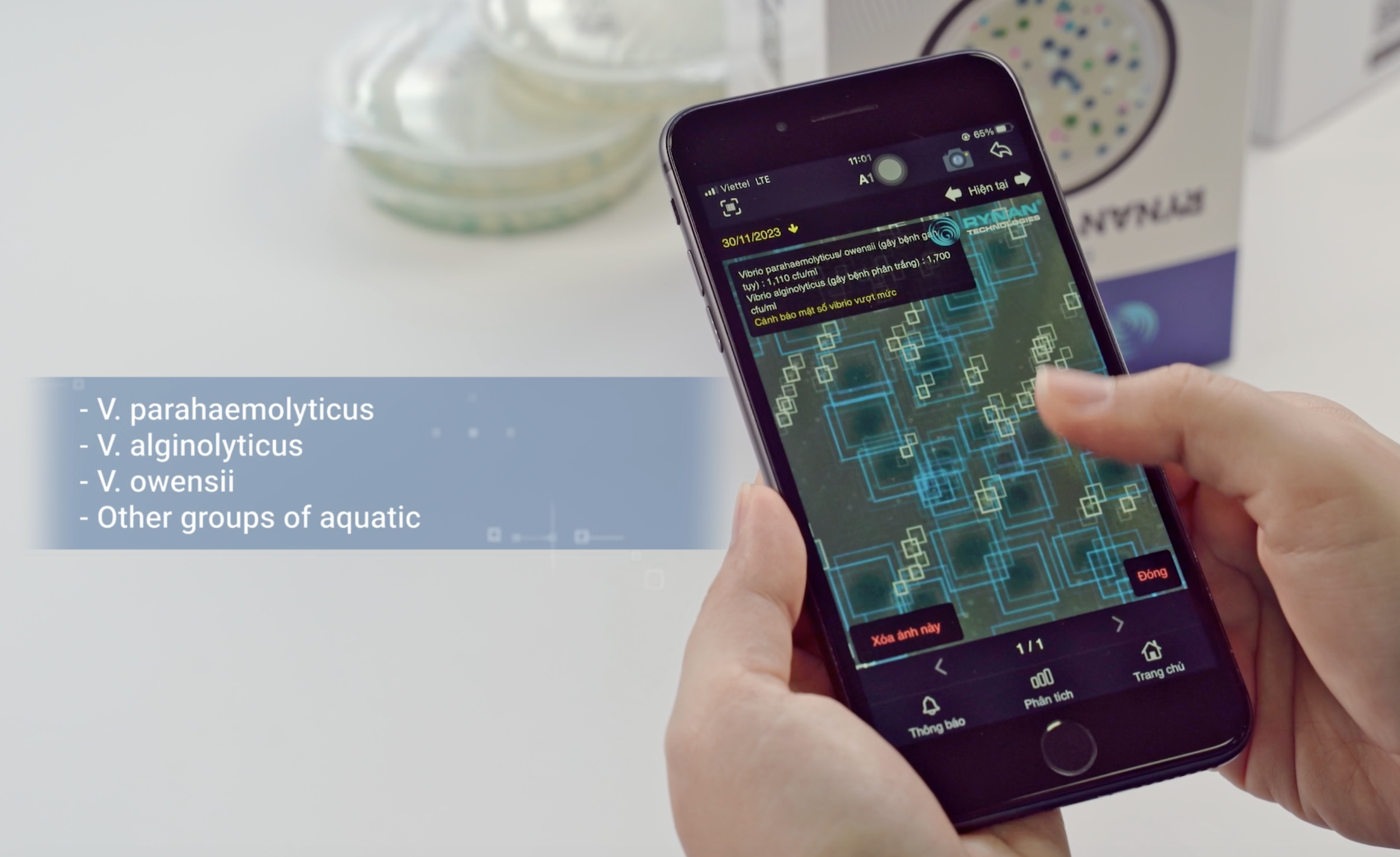
Early risk detection gives farms more time to respond before environmental stress becomes a production problem.
6. Risk control: not waiting until shrimp show disease signs
In super intensive shrimp farming, prevention is always more important than late treatment. When stocking density is high, problems can spread faster in the pond, making early risk detection critical.
TOMGOXY combines multiple layers of monitoring to support risk control. In addition to environmental pond data, tools such as the RYNAN AQ-Vibrio Kit help operators assess Vibrio risk more quickly than relying only on laboratory results that may take several days. Shortening the detection time gives farms more information to adjust operations before a problem becomes severe.
At the farm level, the RYNAN Smart Water Quality Monitoring System acts as the central controller for connecting and controlling the IoT device network on TOMGOXY farms. Through the sensor node, the system connects key monitoring parameters such as salinity, pH, dissolved oxygen, water temperature, radar, and oxygen flow, while enabling remote control via the TOMGOXY mobile app.
The important point is that TOMGOXY does not treat environmental risk as a single isolated issue. Risk often emerges from the combination of multiple factors: oxygen, temperature, pH, waste, algae, microbial balance, feeding response, and biomass. Therefore, a more effective approach is to monitor multiple signals at the same time and respond early with the right operational decisions.
Common mistakes when shifting to super intensive shrimp farming
Many farms want to increase stocking density but begin with a list of equipment: more paddlewheels, more feeders, more sensors, or more treatment ponds. However, if these components are not designed to work together, the farm may still face the same old problems.
Some common mistakes include:
Increasing stocking density without redesigning oxygen supply capacity.
Adding more paddlewheels without controlling bottom water movement.
Monitoring DO at only a few points without understanding trends over time.
Feeding based on a fixed schedule without tracking feeding response and pond condition.
Having no clear strategy to collect and remove waste as biomass increases.
Expanding from a few ponds to many ponds without standardizing operations.
Collecting fragmented data without connecting the data to specific farm actions.
This is why a high-density farming model should not be evaluated only by visible equipment. It should be evaluated by its ability to operate consistently throughout the crop.
TOMGOXY is not just equipment. It is an operating model.
The difference of TOMGOXY does not lie in each device as a standalone component. It lies in how these components are designed to work together as one integrated operating system.
The pond structure provides the foundation for directing water movement and concentrating waste. On top of that foundation, the RYNAN MFD supports controlled water circulation and oxygen distribution within the pond. The RYNAN Oxygen Generator provides a more stable oxygen supply for high-density farming conditions, while monitoring devices continuously capture changes in the pond environment over time.
Data from the pond is then combined with tools such as AQ-Vision, the Vibrio Kit, and the TOMGOXY app to help operators assess growth, monitor risk, and identify the right timing for intervention.
When these layers are connected, the farm is not simply “stocking at higher density.” It gains better control over the factors that determine crop performance, including oxygen, waste, feed, growth rate, pond health, and harvest timing.
This is how TOMGOXY supports the transition from shrimp farming that relies heavily on manual reaction to a more structured, data-supported operating model that can be standardized more effectively as the farm scales.
How to measure the performance of a super intensive shrimp farm
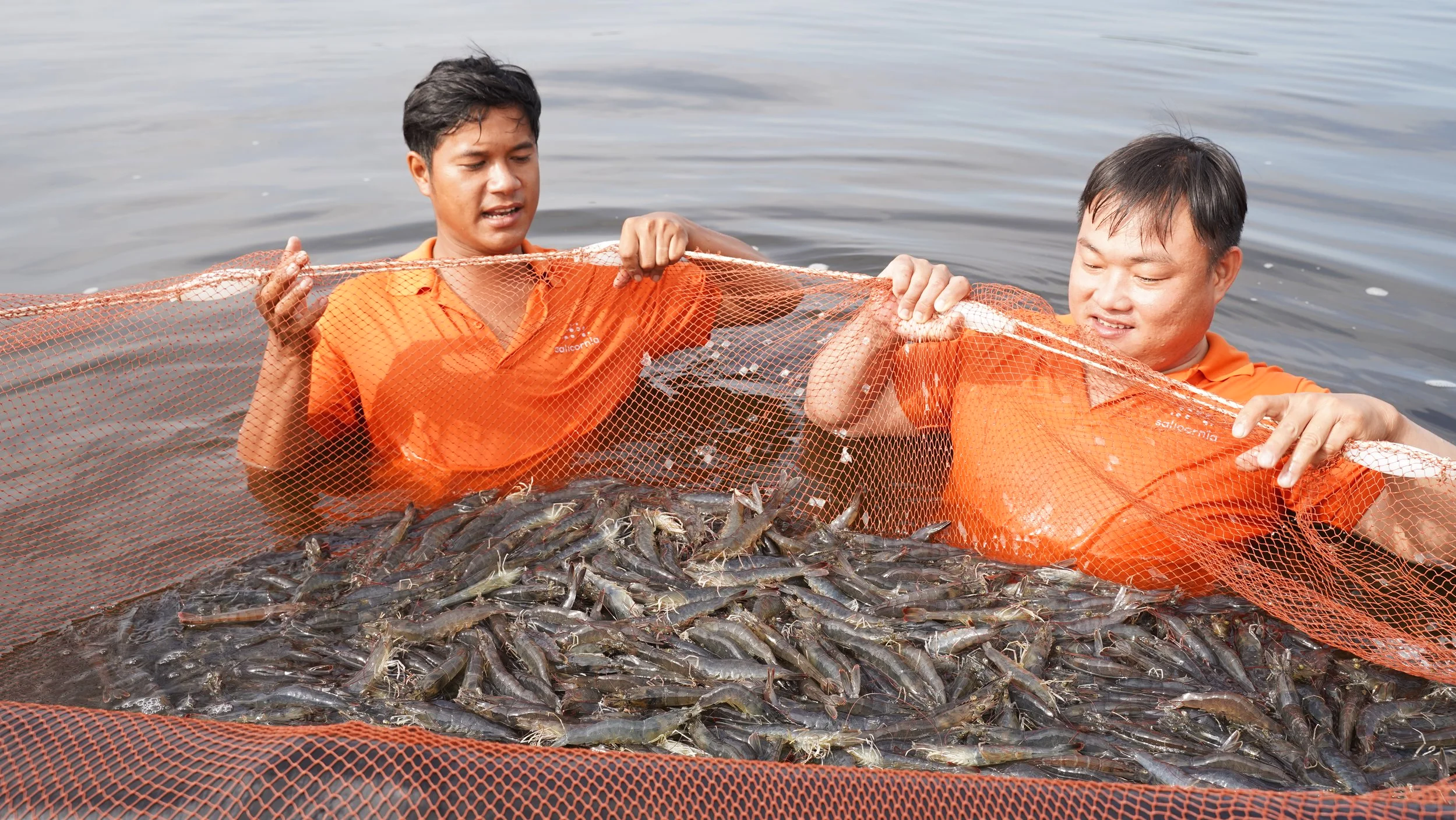
Harvest results are only one part of farm performance.
A super intensive shrimp farm should not be evaluated only by final harvest volume. High production is meaningful only when it is supported by cost control, risk control, and consistent performance across ponds.
Important indicators to monitor include:
Stocking density and survival rate.
Growth rate and harvest size.
FCR and feed efficiency.
Electricity consumption per kilogram or per ton of shrimp.
Dissolved oxygen stability, especially at night and during the later stages of the crop.
Siphoning frequency and waste collection volume.
Vibrio levels and other environmental risk indicators.
Consistency across ponds within the same farm.
Ability to standardize operations when scaling up.
These indicators help investors and operators better understand the real performance of the model instead of looking only at stocking density or production from a single pond.
Conclusion: the future of high-density shrimp farming depends on system design
Super intensive shrimp farming is not about pushing stocking density as high as possible at any cost. It is about designing a system that can control the pond environment, biomass, and operational decisions with greater precision.
With TOMGOXY, RYNAN approaches high-density shrimp farming as a system challenge: from pond structure, water movement, oxygen, waste collection, environmental data, growth monitoring, risk control, and harvest decisions.
When these elements are connected, a farm can produce more on the same land area while reducing dependence on manual reaction and fragmented experience.
As land, water, operating costs, and climate risks continue to put pressure on the shrimp farming industry, the question is no longer simply: “Should farms move toward higher density?”
The more important question is:
Has the farm been designed well enough to operate high-density shrimp farming in a stable, efficient, and controlled way?
If you are planning to build or upgrade a super intensive shrimp farm, RYNAN can support you from system design and technology configuration to standardized farm operations.
Contact RYNAN Aquaculture to design a farm that performs today and scales tomorrow.